Table of contents (16 sections)
- 1. What "wrongful termination" actually means in the United States
- 2. The five federal protections every US employee has
- 3. State-by-state variations: where you have extra protection
- 4. Discrimination-based firing: how to recognize it
- 5. Retaliation: the most common wrongful termination
- 6. Constructive discharge: when "quitting" is actually being fired
- 7. WARN Act and mass layoffs: your 60-day right
- 8. The EEOC charge process: timeline and what to expect
- 9. State agencies: where your local complaint goes
- 10. Settlement vs litigation: what these cases really pay
- 11. Mistakes that destroy your case before you start
- 12. Finding the right wrongful termination attorney
- 13. Severance negotiation: the playbook nobody teaches you
- 14. Frequently asked questions
- 15. Industry-specific considerations
- What to do next
Wrongful Termination in the US: The 2026 Guide That Says What Most Lawyers Won't
You walked into work on a Tuesday. By 10:00 a.m. you were carrying a cardboard box to your car. Maybe security was waiting. Maybe HR handed you a single sheet of paper with the word "performance" on it. Maybe nobody said anything at all and your badge just stopped working.
Now you're at home, and a friend told you to call a lawyer because "they can't do that." A coworker said the opposite: "It's at-will. They can fire you for any reason." Your brother-in-law said something about "the union" even though there isn't one. Three Reddit threads later, you don't know whether you have a $300,000 case or whether you should just update your LinkedIn and move on.
This guide is the version I would write for my own sister if she got fired tomorrow. It's long because the answer is genuinely complicated, and the short answers people give you on the internet are usually wrong in ways that cost you the case. I'll tell you when at-will employment actually protects an employer, when it doesn't, what numbers these cases settle for, and the specific mistakes that destroy claims in the first 72 hours after termination.
I am not your lawyer. I do not know your state, your contract, your protected characteristics, or the timeline of what happened. Nothing here is legal advice. But by the end of this, you'll have enough vocabulary to walk into a consultation and know whether the attorney across the desk is taking you seriously or trying to bill you for a case that doesn't exist.
1. What "wrongful termination" actually means in the United States
Here is the thing nobody explains clearly: in 49 of the 50 states, your employer can fire you for almost any reason, including reasons that feel grossly unfair. They can fire you because they don't like your hair. They can fire you because your boss is in a bad mood. They can fire you because they hired your replacement two weeks ago and just hadn't told you yet. None of that is illegal.
This is the doctrine of "at-will employment," and it has been the default rule in American labor law since Payne v. Western & Atlantic Railroad (Tenn. 1884). The only state that genuinely departs from it is Montana, where the Wrongful Discharge from Employment Act (Mont. Code Ann. § 39-2-901 et seq.) protects employees from being fired without "good cause" after a probationary period. Everywhere else, you can be fired for breakfast.
So why does "wrongful termination" exist as a legal category? Because at-will has exceptions, and those exceptions are exactly where employees win cases. The exceptions are:
Statutory exceptions. Congress and state legislatures have passed laws that override at-will. You can't be fired because of a characteristic the law protects, because of an activity the law protects, or because of the exercise of a right the law protects. Title VII of the Civil Rights Act of 1964 (42 U.S.C. § 2000e) is the most famous example. The list is long, and we'll go through it.
Contract exceptions. If you have a written employment contract, a collective bargaining agreement, or in some cases an enforceable promise from an employee handbook, at-will is contracted around. The contract controls.
Public policy exceptions. Most state courts have recognized that employers can't fire workers for refusing to do something illegal (lying to investigators, ignoring safety regulations, falsifying records) or for exercising a clearly defined public right (jury duty, voting, reporting a crime). The contours vary by state.
Implied contract exceptions. A minority of states will treat an employee handbook, a long pattern of "we only fire for cause" statements, or specific oral promises as creating an implied contract that limits termination. California and Massachusetts are the most aggressive on this; Texas and Florida largely reject it.
Implied covenant of good faith and fair dealing. A handful of states (most notably California for limited situations, plus Alaska, Idaho, Massachusetts, Montana, Nevada, Utah, Wyoming) recognize that even at-will relationships carry an obligation not to act in bad faith. Most employees don't win on this theory alone.
When your friend says "they can fire you for any reason," they're describing the default rule. When your other friend says "they can't do that," they may be pointing at one of the five exceptions. The legal question in your specific case is: does anything that happened to you fit one of those exceptions?
If it does, you may have a wrongful termination claim. If it doesn't, the law won't help you, no matter how unfair the firing felt.

2. The five federal protections every US employee has
Forget what your state does for a moment. There are protections that follow you from Maine to Hawaii, set by federal statute, and they apply to almost every employer with 15 or more employees. These are the heaviest hitters and the foundation of most wrongful termination claims in the country.
2.1. Title VII of the Civil Rights Act of 1964
Codified at 42 U.S.C. § 2000e and following. Prohibits firing because of race, color, religion, sex, or national origin. After Bostock v. Clayton County, 590 U.S. ___ (2020), the Supreme Court confirmed that "sex" includes sexual orientation and gender identity, which means firing someone because they're gay or transgender is illegal under federal law in every state.
Applies to employers with 15 or more employees. The agency that enforces it is the Equal Employment Opportunity Commission (EEOC). The deadline to file a charge with the EEOC is 180 calendar days from the date of the discriminatory act, extended to 300 days if your state has its own anti-discrimination agency that has a worksharing agreement with the EEOC (most states do).
You cannot sue in federal court for a Title VII violation without first filing an EEOC charge and receiving a "Notice of Right to Sue" letter. Skip that step and the court will dismiss your case immediately. This is the single most common procedural mistake I see.
2.2. The Age Discrimination in Employment Act (ADEA)
29 U.S.C. § 621 et seq. Protects workers age 40 and older from discrimination, including termination, because of their age. Applies to employers with 20 or more employees. Same EEOC charge requirement, same 180/300 day deadline. There is no protection under federal law for being fired because you're too young, though a handful of states (notably Michigan and New Jersey) protect against age discrimination at any age.
ADEA cases are factually harder than Title VII race or sex cases because age-related stereotypes are subtler in modern workplaces. Employers rarely write "we want someone younger" in emails anymore. The pattern that wins ADEA cases looks like this: company announces "transformation" or "fresh perspective," fires the workers over 50, replaces them with workers in their 20s and 30s, and the data tells the story.
2.3. The Americans with Disabilities Act (ADA)
42 U.S.C. § 12101 et seq. Prohibits firing because of a disability, real or perceived, if the employee can perform the essential functions of the job with or without reasonable accommodation. The "with or without reasonable accommodation" clause is where most ADA cases live.
The hardest part of an ADA case is the interactive process. When you ask for an accommodation (extended leave, a modified schedule, voice recognition software, a different chair), the employer is required to engage in a good-faith back-and-forth to find a workable solution. Firing you while that conversation is still happening is often the smoking gun.
The ADA Amendments Act of 2008 broadened the definition of "disability" significantly. Conditions that courts used to dismiss as "minor" — diabetes managed with insulin, depression managed with medication, attention deficit disorder, post-traumatic stress — are now clearly within the statute.
2.4. The Family and Medical Leave Act (FMLA)
29 U.S.C. § 2601 et seq. If you've worked for a covered employer (50 or more employees within 75 miles) for 12 months and 1,250 hours in the past year, you're entitled to up to 12 weeks of unpaid, job-protected leave for your own serious health condition, the birth or adoption of a child, or to care for a spouse, parent, or child with a serious health condition. Servicemember caregiver leave can extend to 26 weeks.
Firing you while you're on FMLA leave, or because you took FMLA leave, or to prevent you from taking it, is "FMLA interference" or "FMLA retaliation," and these are some of the strongest wrongful termination cases in the country. Juries take a dim view of employers who fire pregnant women, new fathers, or workers caring for sick parents.
The statute of limitations is two years from the violation, three if the violation was willful.
2.5. Section 1981 of the Civil Rights Act of 1866
42 U.S.C. § 1981. The forgotten cousin of Title VII. Protects against race discrimination in contracts, including employment contracts. Two big advantages over Title VII: no EEOC filing requirement and a longer statute of limitations (four years for claims under the 1991 amendments). The disadvantage is that it only covers race, not sex or religion or national origin.
If you have a race discrimination claim and you missed the EEOC 300-day deadline, Section 1981 may still save your case. Many plaintiffs file Title VII and 1981 claims together, both to use the full toolkit and because some 1981 remedies (such as punitive damages without the Title VII caps) are more generous.
A note on retaliation
Each of these statutes has its own anti-retaliation provision. If you complain to HR, file an EEOC charge, request an accommodation, take FMLA leave, or participate as a witness in someone else's discrimination case, you cannot be fired for that activity. Retaliation claims are often easier to win than the underlying discrimination claim, because the timeline tells the story: "I complained about my supervisor's behavior on March 4. I was fired on March 20."
If you take nothing else from this section: the moment you put a complaint in writing, you become harder to fire legally, but easier to fire emotionally. Many employers fire complainants out of frustration and pay for it later in court.
3. State-by-state variations: where you have extra protection
Federal law sets the floor. States can — and many do — provide more protection. Where you live matters more than you'd think.
3.1. California
The most employee-friendly state in the country. Beyond Title VII, California's Fair Employment and Housing Act (FEHA), codified at Government Code § 12940 et seq., applies to employers with five or more employees (compared to Title VII's 15-employee threshold). FEHA covers more protected characteristics than federal law, including marital status, medical condition, military or veteran status, and reproductive health decisionmaking.
California recognizes the public policy exception robustly under Tameny v. Atlantic Richfield Co., 27 Cal. 3d 167 (1980), and reads it broadly. Firing an employee for refusing to commit perjury, for filing a workers' comp claim, or for whistleblowing under Labor Code § 1102.5 will support a tort claim with full damages including emotional distress and punitive damages.
The California statute of limitations for FEHA is three years from the date of the violation for filing a complaint with the Civil Rights Department (formerly DFEH).
3.2. New York
The New York State Human Rights Law (N.Y. Exec. Law § 296) applies to all employers regardless of size. The New York City Human Rights Law (N.Y.C. Admin. Code § 8-101 et seq.) is even more aggressive, covering employers with four or more employees and recognizing protections that don't exist federally, such as caregiver status and arrest record discrimination (with limits).
New York has a three-year statute of limitations for state-law claims. New York City complaints can be filed with the Commission on Human Rights or in court.
3.3. New Jersey
The New Jersey Law Against Discrimination (LAD), N.J.S.A. 10:5-1 et seq., is one of the broadest state statutes in the country. It applies to all employers regardless of size, covers an unusually wide set of protected characteristics, and allows for emotional distress damages and punitive damages without the federal caps. The Conscientious Employee Protection Act (CEPA) is the state's whistleblower statute and one of the strongest in the United States.
3.4. Massachusetts
Massachusetts recognizes the implied covenant of good faith and fair dealing in employment, Fortune v. National Cash Register Co., 373 Mass. 96 (1977), and applies it most often to deny employers the windfall of firing a salesperson right before a commission vests. The state's anti-discrimination statute, Mass. Gen. Laws ch. 151B, applies to employers with six or more employees.
3.5. Texas
The other end of the spectrum. Texas is firmly an at-will state with narrow public policy exceptions and no implied contract doctrine to speak of. The Texas Commission on Human Rights Act follows the federal model with the same 15-employee threshold. If you live in Texas and your termination doesn't fit a federal statute, the chances of a successful state-law claim are low.
3.6. Florida
Similar profile to Texas. Florida's at-will rule is robust, the public policy exception is narrow, and the state has not adopted the broad implied contract doctrine. Florida Civil Rights Act follows federal patterns. Whistleblower protections (Fla. Stat. § 448.102) exist but are narrower than California or New Jersey.
The lesson: if you got fired in California, your case is fundamentally different than the same termination in Texas. When attorneys ask "what state are you in," they're not making small talk.
4. Discrimination-based firing: how to recognize it
Most clients walk in convinced their firing was discrimination and have a hard time articulating why. Some clients have crystal-clear evidence and don't realize they have a case. Both situations are common.
Real discrimination cases come in three flavors:
4.1. Direct evidence
The "smoking gun." An email from your supervisor saying "I want her out before she turns 50." A voicemail where your boss says "I'm not promoting any more women into management this quarter." A Slack message complaining that "the disabled guy is going to drag down our metrics."
Direct evidence is rare. When it exists, the case is straightforward. Settle quickly or go to trial — the employer's lawyer knows what these cases pay.
4.2. Circumstantial evidence
Far more common. You build the case piece by piece:
- The timeline (complaint → adverse action within weeks)
- The comparator (a similarly situated employee outside your protected class who did the same thing and was not fired)
- The shifting reasons (the employer told the EEOC one reason, the unemployment office another, you a third)
- The deviation from policy (the handbook says progressive discipline but you got nothing)
- The statistical pattern (every supervisor over 50 was let go during the "transformation")
A skilled employment attorney builds this case the way a prosecutor builds a circumstantial case in a criminal trial. The strength of any single piece doesn't matter; the cumulative weight does.
4.3. Mixed motive
A more recent doctrine that says even if the employer had a legitimate reason for firing you, if discrimination was also a motivating factor, you have a claim. The Civil Rights Act of 1991 codified this for Title VII. For ADEA, the rule is harder; under Gross v. FBL Financial Services, 557 U.S. 167 (2009), age must be the "but-for" cause.
Mixed motive cases pay less but are easier to prove. If the employer had three reasons and one of them was your pregnancy, you have a claim.
The factual investigation is brutal in these cases. Expect to gather everything: your performance reviews going back five years, every email you can access, your direct deposit history (to prove pay gaps), the org chart before and after, the press releases announcing layoffs, the demographics of who stayed and who went. A good attorney will tell you exactly what to preserve before the company's IT department starts deleting things.
5. Retaliation: the most common wrongful termination
If you take one practical lesson from this guide, take this: retaliation cases are the most winnable wrongful termination cases in the United States. They are also the most common reason employees actually walk away with money.
A retaliation claim has three elements:
- You engaged in protected activity (filed a complaint, requested an accommodation, took FMLA leave, reported safety violations, refused to do something illegal, etc.)
- You suffered an adverse action (most commonly termination, but also demotion, pay cut, schedule changes that hurt you)
- There is a causal connection between the protected activity and the adverse action
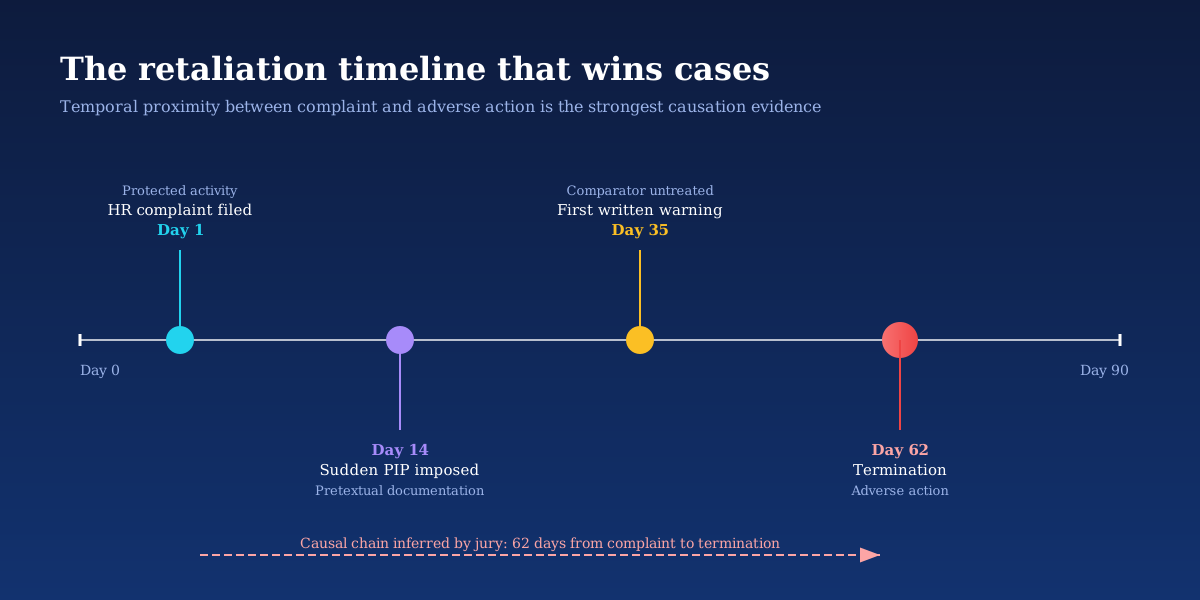
Element three is where cases are won or lost. Temporal proximity is the most powerful evidence. Complaint to HR on Monday, termination on Friday is a near-automatic case. Complaint in March, termination in November with a documented performance trajectory in between is a harder case but still winnable if the documentation is suspect.
Things that count as protected activity:
- Filing a charge with the EEOC, OSHA, NLRB, DOL, or state equivalent
- Making an internal complaint to HR about discrimination, harassment, wage theft, or safety
- Refusing to participate in illegal conduct
- Requesting reasonable accommodation under ADA or pregnancy laws
- Taking or requesting FMLA leave
- Participating as a witness in someone else's complaint or investigation
- Engaging in protected concerted activity under NLRA (discussing wages with coworkers, organizing)
- Reporting securities violations to the SEC under Dodd-Frank
- Reporting healthcare fraud under the False Claims Act qui tam provisions
Things that do not count:
- Complaining about your boss being rude (without tying it to a protected category)
- Complaining about general unfairness
- Complaining about being underpaid relative to your perceived worth (without tying it to a wage and hour violation or pay equity claim)
- Complaining after you knew you were already being terminated (the timing kills causation)
The dance employers do in retaliation cases is to manufacture a "legitimate non-retaliatory reason." Suddenly, after a complaint, your reviews drop. You're put on a PIP for issues that nobody mentioned six weeks ago. You get a written warning for being five minutes late, which everyone in the department does. These are the exact patterns juries reject.
6. Constructive discharge: when "quitting" is actually being fired
You weren't formally terminated. You resigned. But you resigned because the working conditions had become unbearable in a way that was tied to discrimination, retaliation, or unlawful behavior. In that case, you may have been "constructively discharged" — the law treats your resignation as if it were a firing, with all the same remedies available.
The legal standard is high. Working conditions must be so intolerable that a reasonable person in your position would have felt compelled to resign. Pennsylvania State Police v. Suders, 542 U.S. 129 (2004), set the federal standard for sexual harassment-based constructive discharge: the working environment must be so hostile that resignation was a fitting response.
What courts will accept:
- Severe and pervasive harassment that HR refused to address after multiple complaints
- A dramatic and unjustified demotion that strips authority, pay, and dignity
- A forced transfer to a far-away office with no business justification
- Repeated public humiliation by a supervisor
- Outright pressure to quit ("you should resign now or this will get worse")
What courts will reject:
- A single unpleasant conversation
- A negative performance review you disagree with
- Being assigned more work than you'd like
- A demanding boss with high standards applied across the board
The practical lesson: if you're being squeezed out, don't resign until you've talked to a lawyer. Once you walk out the door voluntarily, you have a much harder uphill climb to prove constructive discharge. Sometimes the right move is to wait to be fired, document everything in the meantime, and let the employer make the affirmative decision.
7. WARN Act and mass layoffs: your 60-day right
The Worker Adjustment and Retraining Notification Act, 29 U.S.C. § 2101 et seq., is one of the most misunderstood statutes in employment law. It does not protect you from being laid off. It protects you from being laid off without warning.
WARN applies when an employer with 100 or more employees:
- Orders a plant closing affecting 50 or more employees at a single site
- Orders a mass layoff affecting 500 or more employees at a single site, or 50 to 499 employees if they constitute at least 33% of the workforce
When WARN applies, the employer must give 60 calendar days' written notice to affected employees, the state's dislocated worker unit, and the chief elected official of the local government. Notice must include specific information: whether the action is permanent or temporary, expected date, identity of the position, and bumping rights if any.
The remedy for a WARN violation is back pay and benefits for each day of violation, up to 60 days. So if you were given zero days of notice when you were entitled to 60, the company owes you 60 days of pay. Add in attorney's fees and the math works in your favor.
Some states have their own "mini-WARN" statutes that are stricter. California's WARN Act (Cal. Labor Code § 1400 et seq.) applies at lower thresholds and includes broader definitions of "mass layoff." New York, New Jersey, and Illinois also have state WARN statutes with their own quirks.
If you were part of a layoff and the company gave you no advance notice or a much shorter notice than 60 days, this is one of the easiest claims to investigate. Pull the layoff numbers, check the WARN thresholds, and see what the company actually filed with the state. Many smaller plaintiff firms have built whole practices around WARN class actions.
8. The EEOC charge process: timeline and what to expect
If your claim involves discrimination or retaliation under Title VII, ADEA, ADA, or GINA, you must file a charge with the EEOC before you can sue. Here is the actual process, in plain English.
8.1. File the charge
You can file online at eeoc.gov, by mail, by phone, or in person at a field office. The form is short and asks for basic information: who you are, who the employer is, when the discrimination happened, what protected characteristic was the basis, and a brief description.
You do not need a lawyer to file. The EEOC intake is designed to be accessible. But filing without a lawyer is risky for one reason: the way you describe the events on the charge can box in your case later. Statements you make to the EEOC can be used against you in litigation. If at all possible, consult a lawyer before you file.
The deadline is 180 days from the discriminatory act, extended to 300 days in "deferral" states (almost everywhere). Calculate from the date of the firing, not the date you found out about it. Time you spent thinking about whether to file does not toll the deadline.
8.2. Investigation phase
After filing, the EEOC notifies the employer and asks for a "position statement." This is the company's written explanation. You may be asked to provide a rebuttal. The investigator may interview witnesses, request documents, and ask both sides for additional information.
Most charges are not actively investigated to a conclusion. The EEOC is chronically underfunded. The realistic timeline is 6 to 18 months from filing to disposition. About 70% of charges close with a "no reasonable cause" finding or a dismissal without investigation. About 15% result in mediation or settlement. The rest are referred for litigation.
8.3. Mediation
EEOC offers free voluntary mediation. Both parties have to agree. Many employers will agree because mediation is confidential and fast — typically a single day with a neutral, who shuttles between two rooms.
Mediation works well for cases where both sides want closure and disagree mostly on dollar amounts. It works poorly for cases where one side denies the underlying facts.
8.4. Right to sue
If the EEOC dismisses your charge or you ask for a Right to Sue letter at any time (after 180 days from filing), you have 90 days from receipt of the letter to file a lawsuit in federal court. Miss this 90-day deadline and your case is gone forever.
If the EEOC finds reasonable cause and the employer refuses to conciliate, the EEOC may sue on your behalf. This is rare. In most cases, you'll need to hire your own lawyer for the lawsuit phase.
8.5. After the Right to Sue
This is where the real money cases happen. The lawsuit can be filed in federal or, often, state court if state-law claims are also pleaded. Discovery follows: depositions, document production, expert witnesses for damages calculations, sometimes statistical experts in pattern cases. Most cases settle during discovery; trials happen in maybe 5% of filed cases.
If the case goes to trial and you win, available remedies under Title VII include reinstatement (rare in practice — nobody wants their old job back after this), back pay, front pay, compensatory damages for emotional distress, punitive damages (with statutory caps tied to employer size, ranging from $50,000 for small employers to $300,000 for the largest), and attorney's fees.
The damage caps are why many plaintiffs add state-law claims with no cap. A California FEHA verdict can blow through the federal cap by an order of magnitude.
9. State agencies: where your local complaint goes
Every state has its own anti-discrimination agency. Most have worksharing agreements with the EEOC, which means a charge filed with the state is automatically dual-filed with the EEOC and vice versa. You don't have to file twice.
A non-exhaustive list:
- California: Civil Rights Department (CRD, formerly DFEH)
- New York: New York State Division of Human Rights (NYSDHR) and the New York City Commission on Human Rights (NYCCHR)
- New Jersey: New Jersey Division on Civil Rights (NJDCR)
- Texas: Texas Workforce Commission Civil Rights Division
- Florida: Florida Commission on Human Relations (FCHR)
- Massachusetts: Massachusetts Commission Against Discrimination (MCAD)
- Illinois: Illinois Department of Human Rights (IDHR)
- Pennsylvania: Pennsylvania Human Relations Commission (PHRC)
Whether to file with the state agency or the EEOC depends on which set of remedies you want and how each agency processes cases. In California, FEHA gives you better damages than Title VII, so filing with CRD makes sense. In states like Texas, the federal route is usually stronger.
This is the kind of decision your lawyer makes for you in the first meeting. If you're shopping for a wrongful termination attorney and they don't ask you what state you live in and which agency to file with, find another lawyer.
10. Settlement vs litigation: what these cases really pay
Clients want a number. I'll give you ranges, with the caveat that every case is fact-specific and the value of yours depends on facts I don't know.
Low value cases ($5,000 to $50,000): a marginal claim with weak evidence, a low-earning plaintiff, or a small employer with limited insurance. Most workers' rights advocates will tell you to settle in this range and move on rather than spend two years in litigation.
Mid value cases ($50,000 to $250,000): a solid discrimination or retaliation case with a documented complaint, a clean timeline, a comparator, and a plaintiff earning $60,000-$100,000. This is the meat of employment litigation. Most attorneys take these on contingency at 33-40%.
High value cases ($250,000 to $1,000,000): strong evidence of discrimination, a long-tenured employee with significant lost income, harm to professional reputation, emotional distress with treatment records, and a defendant with deep pockets. Often involve executive-level plaintiffs or pattern cases.
Catastrophic cases ($1,000,000+): pattern-and-practice cases, class actions, named plaintiffs in major brand-damaging litigation, severe sexual harassment with corporate cover-up, or whistleblower retaliation with significant fraud uncovered. These are the cases you read about in the Wall Street Journal.
Most cases settle. Less than 10% of filed discrimination cases reach a verdict. Of those that do, employers win about two-thirds. That sounds discouraging until you realize that the cases that go to verdict are not random — they're the cases where settlement broke down because one side overvalued or undervalued. The selection effect skews the data.
The single best predictor of settlement value is the strength of your documentation in the first 72 hours after termination. Which brings us to the next section.
11. Mistakes that destroy your case before you start
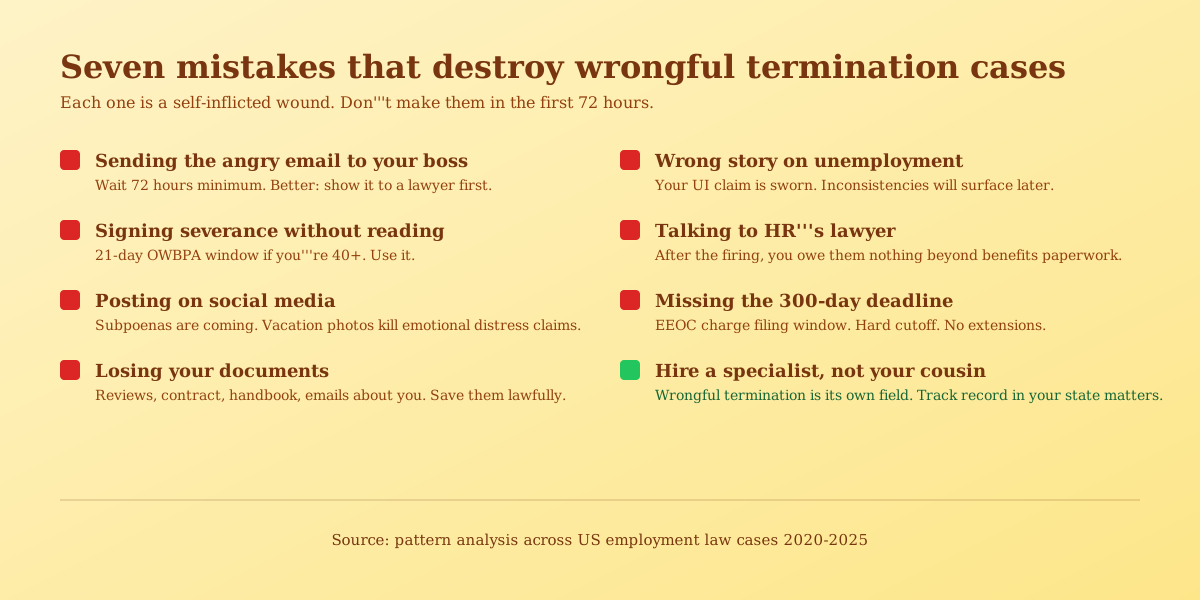
I see the same mistakes over and over. Each of these is a self-inflicted wound that costs cases.
Sending an angry email to your boss after the firing. The first impulse is to write the message you've been holding back. Don't. Anything you write in the immediate aftermath becomes evidence the employer's lawyer will read aloud in deposition. Sit on the email for 72 hours, then ideally show it to a lawyer before sending. Better: don't send it.
Signing a severance agreement without reading it. Severance comes with strings. The agreement will typically include a broad general release of all claims, sometimes a non-disparagement clause, sometimes a non-compete or non-solicitation, sometimes a confidentiality provision that covers the existence of the severance itself. Once signed, your wrongful termination claim is gone, even if it was worth ten times the severance. Under the Older Workers Benefit Protection Act, employees over 40 get 21 days to consider and 7 days to revoke. Use them.
Posting about the firing on social media. The job market knows. Your future employer doesn't need to know the details. Every social media post becomes potential evidence. The employer's lawyer will subpoena your accounts. Pictures of you on vacation will be used to argue you weren't really emotionally distressed. Posts complaining about coworkers will be argued as evidence of why you were really fired.
Losing the documents. Before security walks you out, you may have access to your work email, files, performance reviews, internal Slack messages, training records. Once the door closes, those are gone. The legal/ethical line is: you can take copies of documents that relate to your own employment, your performance, communications about you, and your compensation. You cannot take confidential customer data, trade secrets, or material outside your role. Talk to an attorney about specifics in your state.
Filing for unemployment with the wrong story. Your unemployment claim creates a sworn record. If you tell the unemployment office that you were "laid off due to restructuring" and later tell the EEOC you were "fired because of retaliation for my pregnancy complaint," that inconsistency will be devastating. Get the story straight before you file anything.
Talking to HR's lawyer. After the firing, the company may call you to "wrap things up." It may sound friendly. It is not. Anything you say can be used against you. Once you've been fired, you have no obligation to give the employer information beyond what's required by your benefit plans (COBRA election, 401(k) rollover, etc.). Let your lawyer handle communications.
Waiting too long. The 300-day EEOC deadline, the 90-day Right to Sue deadline, the state-law statute of limitations — these are hard deadlines. Even competent lawyers can't fix a missed deadline. Time is the enemy of every wrongful termination case.
Hiring the wrong lawyer. Family law attorneys can do divorces. Personal injury attorneys can do car accidents. Wrongful termination is a specialty. The lawyer's track record in employment cases, particularly in your state and your industry, is the single most important data point.
12. Finding the right wrongful termination attorney
Most employment attorneys offer a free initial consultation. Use this. Schedule with three or four firms in your state before deciding. The consultations will teach you which lawyer is realistic, which is overpromising, and which is taking you seriously.
What to bring to the consultation:
- The termination letter or notice (if any)
- Your most recent performance reviews
- Your offer letter and any employment contracts
- The employee handbook (or the page that covers termination procedures)
- A written timeline of events with dates, names, and key conversations
- Any emails, texts, or recordings (in single-party consent states) that document key events
- Pay stubs and tax forms (W-2s for the last three years if possible)
What to ask the attorney:
- How many wrongful termination cases have you handled in this state in the past three years?
- What is your typical contingency arrangement? Do I owe anything if we lose?
- Who will actually work on my case — you, an associate, a paralegal?
- What is the realistic timeline if we file? If we settle?
- What is my case worth, in your honest assessment, and what is the realistic range?
- What weaknesses do you see?
- What is the next step?
Red flags:
- The lawyer promises a specific dollar amount. Anyone who promises you a settlement number in the first meeting either doesn't know the case yet or is selling.
- The lawyer wants money up front. Real wrongful termination work is almost always contingency-based. Costs (filing fees, expert witnesses) may be advanced and recovered from the settlement, but the legal fee itself rarely comes out of pocket.
- The lawyer hasn't asked you about deadlines. If they don't immediately check whether you're within the EEOC window, find another firm.
- The lawyer hasn't asked about other employees. Pattern cases multiply value. If they're not curious, they're missing leverage.
A solid match feels like a doctor giving you a diagnosis. Specific, sober, with a clear next step. If the consultation leaves you more confused than when you walked in, you have the wrong lawyer.
13. Severance negotiation: the playbook nobody teaches you
You're sitting in HR. A folder slides across the table. Inside is a separation agreement offering you eight weeks of pay if you sign. The HR director, who has been pleasant for months, is suddenly using a careful, scripted voice. "You have 21 days to consider, but we'd love to wrap this up by Friday."
There is a system for handling this moment. Most people fumble it because nobody taught them. Here is the system.
13.1. Do not sign anything in the room
This is the single most expensive mistake people make. The agreement will sit on your kitchen table just as easily as on the HR director's desk. Tell them, "I appreciate the offer. I need to review this carefully. I'll be in touch." Then leave. If they push back, repeat the same sentence. The Older Workers Benefit Protection Act gives employees over 40 a statutory right to 21 days to consider, plus 7 days to revoke after signing. The company knows this. Use the time.
13.2. Calculate your real BATNA
BATNA — best alternative to a negotiated agreement — is the number you would walk away with if you didn't sign. Three components:
- Your unemployment benefits. Most states pay between $300 and $600 per week for up to 26 weeks. That is between $7,800 and $15,600 in support, regardless of severance.
- Your wrongful termination claim, weighted by probability. Honest assessment: if your case is 30% likely to settle at $100,000, your expected value is $30,000. Discount further for time (two years to resolve) and legal fees (33%).
- Your job market window. How long will you realistically be unemployed? In a hot market for your skills, 8 weeks of severance might be a windfall. In a cold market, it's coffee money.
Add the three. That's your floor. The severance offer needs to clear it for "sign now" to make sense.
13.3. Know what to negotiate
Severance pay is the obvious lever. But experienced negotiators ask for:
- Cash severance in lieu of, or in addition to, the offered amount
- COBRA premium reimbursement for 6 to 18 months — a single COBRA payment for a family plan can be $2,000+ per month
- Outplacement services — career coaching, resume review, paid for by the company
- A neutral reference letter signed and on file with HR, so future employer calls return a benign script
- Mutual non-disparagement — not just you agreeing not to badmouth the company, but the company agreeing the same
- Carve-outs from the release — you keep the right to file an EEOC charge, report violations to the SEC, or testify if subpoenaed
- Removal of overly broad non-compete language — recent FTC rulemaking and state statutes have narrowed enforceability, but employers still try to include it
- Vesting of equity that would otherwise be forfeited on the termination date
- Conversion of unused PTO to cash (some states require this anyway)
Each of these has value. Adding three of them to a base severance offer can effectively double the package without the company writing a much bigger check.
13.4. The counter-offer letter
Send a written counter-offer with a clear structure: enumerate what you accept, what you propose to change, and the deadline by which you will respond once they reply. Two paragraphs. Calm tone. No threats, no anger, no recitation of grievances. The negotiation works because you're keeping it transactional.
Sample structure:
"Thank you for the separation proposal dated [date]. I am prepared to accept the agreement with the following modifications: (1) severance increased from 8 weeks to 24 weeks; (2) COBRA premium subsidy for 6 months; (3) a neutral written reference signed by [name]; (4) addition of mutual non-disparagement language. With these changes, I am prepared to sign and waive the 7-day revocation period. Please confirm by [date]."
That is a letter that gets read by counsel, not HR. Counsel evaluates the request on a cost basis. Often the company says yes to most of it because the alternative — litigation — costs them five to ten times more.
13.5. When to walk away from severance entirely
If your case is strong (clear discrimination evidence, retaliation timeline, comparator who was treated better), and the severance offer is paltry relative to the case value, walking away is correct. Counsel will sometimes advise rejecting severance entirely and filing a charge instead. The math: an $8,000 severance forfeits a potential $150,000 case. That's not a hard call.
The risk: rejecting severance to pursue a claim that ultimately yields nothing leaves you with neither. A good lawyer makes this call honestly. A bad lawyer pushes you toward the bigger case because the bigger case pays them better.
13.6. When to take the severance gratefully
Sometimes the right answer is sign. A clean exit, decent money, no two-year litigation drag, the ability to move on. The cases where this is right:
- Your termination doesn't fit a federal or state statute
- The severance approximates or exceeds your honest assessment of expected case value
- The release does not include language you actively object to (broad non-competes, gag orders, return of equity)
- You have a job offer lined up that requires you to start in 4 weeks
There is no shame in signing. The shame is in signing without reading and finding out later you traded a $300,000 case for $12,000.
14. Frequently asked questions
Can I be fired for any reason in the US?
In 49 states, yes, with five major exceptions. You cannot be fired because of a protected characteristic (race, color, religion, sex including pregnancy and LGBTQ status, national origin, age 40+, disability, genetic information, and in many states more). You cannot be fired in retaliation for protected activity. You cannot be fired in breach of an employment contract. You cannot be fired in violation of a clear public policy. And in some states, you cannot be fired in violation of an implied contract or covenant of good faith.
How long do I have to file a wrongful termination claim?
For federal discrimination claims (Title VII, ADEA, ADA), 180 days from the discriminatory act, extended to 300 days in states with a worksharing agreement with the EEOC (most states). For Section 1981 race discrimination claims, up to four years. For state-law claims, between one and four years depending on the state and the specific statute. For FMLA, two years (three if willful). Talk to a lawyer immediately — deadlines do not pause while you think about it.
Do I need to file with the EEOC before I can sue?
Yes, for Title VII, ADEA, and ADA claims. No, for Section 1981, FMLA, ERISA retaliation, or most state-law claims (though most states have their own administrative filing requirement). The procedural rules are technical and easy to get wrong without counsel.
What's the difference between wrongful termination and unfair termination?
Wrongful termination is a legal category — a firing that violates a specific law. Unfair termination is a moral category — a firing that feels wrong. The two often overlap but not always. Many genuinely unfair firings are completely legal, and the law cannot help you. The first job of an employment lawyer is to translate "unfair" into either "wrongful" or "not actionable."
How much does a wrongful termination lawyer cost?
Almost all reputable employment attorneys work on contingency for plaintiff-side cases. You pay nothing up front. The lawyer typically takes 33% to 40% of any recovery, plus reimbursement of costs (filing fees, expert witness fees, deposition transcripts) from the settlement. If the case loses, you typically owe nothing. Read the fee agreement carefully — the specifics vary by firm.
Can I be fired while on FMLA leave?
You can be fired during FMLA leave for reasons unrelated to the leave (genuine layoffs, documented unrelated misconduct), but you cannot be fired because of the leave or to prevent you from completing it. The employer bears the burden of proving that the termination would have happened regardless of the leave. These are some of the strongest wrongful termination cases.
What if my employer offers me severance — should I sign?
Not without showing it to a lawyer. The severance agreement typically includes a general release of all legal claims, which means you give up any wrongful termination case in exchange for the severance dollars. Sometimes the trade is good (severance is fair, the case is weak). Sometimes it is catastrophic (severance is $5,000, the case is worth $200,000). The lawyer can negotiate the severance up or advise you to reject it and pursue the claim. Federal law (the Older Workers Benefit Protection Act) gives employees over 40 a minimum of 21 days to consider and 7 days to revoke; use the time.
Can I record my conversations at work?
It depends on your state. In one-party consent states (most of the country), you can record a conversation as long as one party (you) consents — meaning your own conversations are fair game. In two-party consent states (California, Florida, Illinois, Maryland, Massachusetts, Montana, New Hampshire, Pennsylvania, Washington, and a few others), all parties must consent or the recording is illegal and inadmissible. Even in one-party states, the company handbook may forbid recordings and use a violation as grounds for termination. The advice: check your state law, check the handbook, and ask a lawyer before relying on a recording as evidence.
15. Industry-specific considerations
Different industries operate under different legal regimes. The general wrongful termination playbook applies, but specific industries layer additional protections that change the math.
Federal employees. Federal workers do not file with the EEOC for most discrimination claims. They file with the agency's EEO counselor within 45 days, then proceed through a formal complaint process that ends with the Merit Systems Protection Board (MSPB) or the EEOC's Federal Sector. Whistleblower protections are stronger under the Whistleblower Protection Enhancement Act of 2012. The deadlines are aggressive and the process is procedural — a federal employment specialist is essential.
Healthcare workers. Nurses and physicians have additional layers. Reporting patient safety concerns is protected under federal Joint Commission rules and state-specific nursing whistleblower statutes (California Health and Safety Code § 1278.5 is one of the strongest). Termination shortly after a safety report is the classic retaliation case in this sector. Hospital systems often settle these cases quietly to avoid licensing complications.
Financial services. Sarbanes-Oxley Section 806 and Dodd-Frank Section 922 protect employees who report securities violations from termination. The Dodd-Frank SEC whistleblower program also offers monetary awards (10-30% of sanctions over $1 million). The combination of anti-retaliation protections plus financial incentive makes these cases distinctive.
Tech industry. Equity vesting is the silent battlefield in tech terminations. A four-year vesting cliff makes the timing of a termination worth six or seven figures. Companies sometimes terminate just before a vesting date for ostensibly performance reasons. The remedy: ask whether the firing was timed to deprive you of vested equity, and if so, raise it in severance negotiations. Some courts have treated this as breach of the implied covenant of good faith. Stock-based compensation also affects the WARN calculation in some interpretations.
Unionized workplaces. Collective bargaining agreements typically include just-cause provisions and grievance procedures. The first stop is usually the union steward, not an outside attorney. Failure to exhaust the grievance procedure can bar a lawsuit. Talk to your union rep before filing externally.
Independent contractors who were misclassified. If you were paid as a 1099 contractor but functionally treated as an employee, you may have been misclassified — and the protections we've discussed in this guide may apply. The Department of Labor and IRS each have their own multi-factor tests. Misclassification cases often combine wage-and-hour claims with wrongful termination claims.
What to do next
If you read this far and you've recently been fired or you're worried you're about to be, here is the short version:
- Don't sign anything today. Severance can wait. Read it with a lawyer.
- Write down the timeline now, while it's fresh. Dates, names, key conversations, who was in the room.
- Save what you can lawfully save of your work documents — performance reviews, your contract, emails about your performance, the handbook section that covers terminations.
- File for unemployment with an accurate account that doesn't lock you into a single story.
- Schedule consultations with three employment lawyers in your state before deciding who to hire.
- Check the 300-day EEOC deadline if discrimination or retaliation is in the mix. Do not let it pass.
- Stop talking to the employer beyond what's required for benefits. Let your lawyer handle communications.
Find an employment attorney in your city or browse attorneys by state on Give Me A Lawyer. Free profile views, direct contact, no intake forms.
Last updated: May 13, 2026. Reviewed by a US employment attorney licensed in good standing. This article is for informational purposes only and does not constitute legal advice. Laws vary by state and change over time. Consult a licensed attorney in your jurisdiction for advice on your specific situation.
Primary sources cited in this article
- EEOC: Filing a Charge of Discrimination — federal procedure, deadlines, contact information for field offices
- U.S. Department of Labor: FMLA — eligibility, leave entitlements, complaint process
- U.S. Department of Labor: WARN Act — covered employers, notification requirements, state mini-WARN statutes
- Bostock v. Clayton County, 590 U.S. ___ (2020) — Title VII covers sexual orientation and gender identity
- Title VII, 42 U.S.C. § 2000e et seq. — Civil Rights Act
- ADEA, 29 U.S.C. § 621 et seq. — Age Discrimination in Employment Act
- ADA, 42 U.S.C. § 12101 et seq. — Americans with Disabilities Act
- Section 1981, 42 U.S.C. § 1981 — Race discrimination in contracts
- California FEHA — Civil Rights Department — state-level enforcement and complaint filing
Additional case law referenced: Tameny v. Atlantic Richfield Co., 27 Cal. 3d 167 (1980); Pennsylvania State Police v. Suders, 542 U.S. 129 (2004); Gross v. FBL Financial Services, 557 U.S. 167 (2009); Payne v. Western & Atlantic Railroad, 81 Tenn. 507 (1884); Fortune v. National Cash Register Co., 373 Mass. 96 (1977).*
Written by
Give Me A Lawyer editorial team
Find related help
Browse lawyers by location and practice area
For readers
Need a real lawyer for this?
Connect with a specialized attorney in your state — verified profiles, no commitment.
Find a lawyer now🛡️ For attorneys · From $2.99/mo
Want your firm to rank for this query?
Activate your Official Verified Badge ($2.99/mo) or upgrade your firm to Top 3 ($19.99/mo) with direct WhatsApp & Dofollow SEO backlink.