
Personal Injury Lawsuit Timeline in the US: From Accident to Settlement (2026)
It was a Wednesday afternoon. A delivery van ran a red light at the corner of 8th and Market and hit her on the driver's side, hard enough that the airbag tore the skin off her left forearm. She remembers the sound — wet, metallic — more than the impact itself. By the time the paramedics arrived she was already arguing with the other driver's passenger about whose fault it was. By the time she got home from the ER her phone had four missed calls from a claims adjuster who was friendly, sympathetic, and asking if she would agree to a recorded statement "just to get the file moving."
She said yes. That single yes, given from a hospital bed on 600 milligrams of ibuprofen, lopped about $40,000 off the eventual value of her case.
This article is the version I would write for a friend who had just been hit by a car, or fallen on a wet floor at a big-box retailer, or watched a loved one be misdiagnosed by a doctor who never read the chart. It is not a marketing page. It is a timeline. The point is to tell you, in order, what happens between the moment of impact and the moment a check clears in your bank account or a jury walks back into the courtroom with a verdict. You will see where the months go, where the money goes, and where insurers go to work against you in ways the small print never warns you about.
I am not your lawyer and nothing here is legal advice. Personal injury law is state-specific, and the rules change. By the end of this guide you will know the vocabulary, the deadlines, the pitfalls, and roughly what a case like yours is worth — enough to walk into a free consultation and tell whether the attorney across the desk has read your file or is just trying to sign you up.

1. What "personal injury" actually means in US law
In the American legal system, personal injury is a branch of tort law. A tort is a civil wrong — distinct from a crime — for which the law allows the injured party to sue for money damages. Personal injury covers harm to the body, mind, or emotions of a person, as opposed to property damage or pure economic loss. If a drunk driver hits you, that is a tort. If a chemist mislabels your prescription and the wrong dose lands you in the ICU, that is a tort. If a deli puts down a freshly mopped floor without a wet-floor sign and you fall, that is a tort.
This is not the same thing that "personal injury" means in many civil-law systems. In those systems, what an American lawyer would call PI may be split across several legal categories, administrative tracks, or statutory compensation frameworks, each with its own procedure. In the United States the categories matter at trial, but the entry point is the same: a single, common-law tort claim filed in a single court, with a jury at the end if the case goes the distance.
There are a handful of features that make US personal injury law its own animal. Three deserve specific attention before we talk timeline.
First, juries. Almost every US personal injury case is triable to a jury, by right, under either the federal Seventh Amendment or the parallel guarantee in the relevant state constitution. A jury can award not just medical bills and lost wages, but pain and suffering, loss of enjoyment of life, and — in egregious cases — punitive damages. American juries award numbers that would shock a continental civil judge. That is the gravitational center of the entire system. Almost every settlement is priced as a discount off what a reasonable jury might do.
Second, contingency fees. Personal injury plaintiffs almost never pay their lawyer by the hour. They pay a percentage of what they recover, and nothing if they recover nothing. This is not how civil litigation works in most of the world; it is the engine that lets ordinary Americans sue large insurers and large companies without going bankrupt in the process. The typical contingency is 33.3% before a lawsuit is filed and 40% after, with the lawyer also advancing costs (filing fees, expert witnesses, deposition transcripts) that are recouped from the settlement.
Third, 51 different bodies of law. Each state has its own statute of limitations, its own rules on comparative fault, its own caps on non-economic damages, its own quirks on whether you can sue a government entity. The federal court system overlays a separate procedural code. Two identical accidents on opposite sides of the same state line can produce wildly different outcomes. There is no one number. Section 13 has the deadline table.
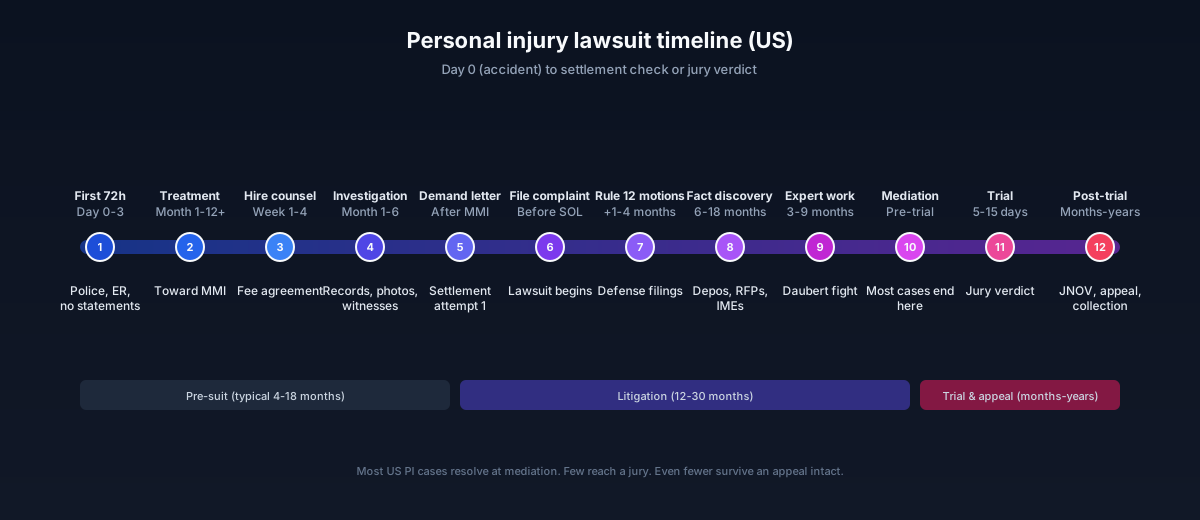
With those three pillars in mind, here is what actually happens between Day 0 and the day you sign a release.
2. The crucial first 72 hours
The first three days after an accident shape every dollar of every offer that follows. I have watched seven-figure cases get gutted in the first afternoon, and I have watched marginal cases survive because the injured person did one thing right at the scene. Insurance adjusters know this window. That is why they are calling so fast.
Here are the eight mistakes I see most often. Read them once now and keep them somewhere you can find them at 11 p.m. on a Tuesday.
Not calling the police. If you do not have a contemporaneous police report from the scene, every fact about how the crash happened becomes "your word against theirs." Defense counsel will spend the first deposition asking why the responding officer was never called. Even in fender-benders that look minor, file a report. The report will list the at-fault party's insurance, their plate, their statement to the officer, and any citations issued. That document anchors the whole case.
Refusing medical attention because you "feel fine." The adrenaline from a serious impact masks pain for hours, sometimes for two or three days. Cervical and lumbar disc injuries in particular present late. If you turn down the ambulance and go to urgent care on Friday after a Wednesday crash, the defense will argue your injuries came from something else. A 48-hour gap is enough to lose tens of thousands in case value. Go to the emergency department the day of impact, even if all you need is an evaluation.
Giving a recorded statement to the other driver's insurance. This is the call that hit my client. The adjuster is friendly because adjusters are trained to elicit informal admissions: "How fast were you going? Were you in a hurry to get somewhere? Have you ever had back problems before?" Any answer becomes ammunition. You owe a recorded statement to your own insurance company under the cooperation clause of your policy. You owe nothing to the other side's carrier. Decline politely and route them to your attorney once you have one.
Apologizing at the scene. Americans say "I'm sorry" reflexively. The other driver's lawyer will read that as an admission against interest under Federal Rule of Evidence 801(d)(2) or the state equivalent. Express concern for everyone's safety, exchange information, and do not narrate fault.
Posting on social media. Defense investigators monitor Facebook, Instagram, TikTok and LinkedIn from the day the claim opens. A photo of you on a hike six weeks after the crash, captioned "feeling great," will be on a giant screen at trial. A "wedding looked amazing" comment will be used to impeach your loss of enjoyment of life. Lock your accounts, do not post about the case or the injury, and assume every public photo will end up in a binder.
Skipping doctor's appointments or PT sessions. A two-week gap in physical therapy is a gift to the defense. Insurers argue you must not have been hurt that badly if you could not be bothered to keep your appointments. This is the "failure to mitigate damages" defense. Show up. If you cannot show up, document why — work, illness, transportation — and reschedule fast.
Throwing away the destroyed bike, the broken helmet, the cracked tail-light. Physical evidence wins cases. Once it is gone, the courts may allow a "spoliation" inference against you for negligent destruction. Keep the helmet in a box in the garage. Photograph the destroyed bicycle from every angle. Save the dashcam footage on three drives. Defense will ask for all of it.
Signing a settlement check the adjuster brings to your hospital room. This actually happens. A "compassionate" early payment of $2,000-$5,000 will be attached to a general release that wipes out every future claim, including the back surgery you do not yet know you will need. Do not sign anything in the first 30 days that has the word "release" on it.
If you do these eight things — call police, get treated, decline statements, do not apologize, lock socials, attend treatment, preserve evidence, do not sign releases — you have already done more than most people who walk into a PI lawyer's office.
3. Medical stabilization and reaching MMI
Personal injury cases are valued on the medical record. The single most important concept in that record is maximum medical improvement, or MMI. MMI is the point at which a treating physician concludes that your condition has stabilized and that further treatment is unlikely to produce significant additional improvement. You are either back to baseline, or you have a permanent residual that will not get better. Until you hit MMI, nobody knows what the case is worth, because future damages cannot be calculated.
That is why your lawyer probably is not sending a demand letter in the first three months. It is not laziness. It is medicine driving litigation. A demand letter sent before MMI undervalues your future medical needs, your future lost earnings, and any permanent impairment rating. If your lumbar disc herniation might require a fusion in eighteen months, the demand has to reflect the cost of the fusion, the cost of recovery, the cost of the rehab, and the loss of function it leaves behind. Send the demand too early and you settle for a fraction of that.
The treatment arc for a typical motor vehicle case looks like this. The ER visit on the day of impact. Follow-up with a primary care doctor or urgent care within 48 hours. Referral to physical therapy, three times a week for six to twelve weeks. If symptoms persist, imaging — usually MRI of the cervical or lumbar spine, depending on where the pain lives. Referral to an orthopedist or pain management specialist. Possibly a steroid injection, possibly two or three. If conservative care fails, a surgical consult. If surgery is recommended and performed, three to six months of recovery and rehab. Then a final functional capacity evaluation. Then MMI.
For a soft-tissue case that responds to PT, the whole arc takes three to six months. For a case with surgery, twelve to eighteen months. For a serious traumatic brain injury or a spinal cord injury, MMI can be two years or more. The litigation calendar bends around the medical calendar, not the other way around.
A practical note that matters more than people realize: how you pay for treatment is part of the case. In no-fault or PIP states like New York, Florida, Michigan, New Jersey, Pennsylvania (limited), Massachusetts, Kentucky and a handful of others, your own auto policy covers initial medical bills up to the PIP limit regardless of fault. Outside no-fault states, you treat through private health insurance, Medicare, Medicaid, or — and this is increasingly common — under a letter of protection (LOP) where a provider agrees to wait for payment until the case settles, in exchange for a lien on the proceeds. Each option has trade-offs your lawyer will walk you through. None of them is free.
4. Finding the right personal injury attorney
This part nobody teaches you. Most PI advertising is volume-based. Big firms run high-frequency TV and billboard campaigns to capture maximum claim flow, run cases through a paralegal-heavy assembly line, and settle aggressively to keep the conveyor moving. That model is fine if your case is a clean soft-tissue rear-end with no contested liability — it will get processed, you will get a check, and the firm will take 33.3% off the top. It is a disaster if your case is even mildly complex, because nobody at the firm has time to fight for the marginal $80,000.
So how do you tell the difference? A few honest signals.
A real PI lawyer will tell you on the first call what they think your case is worth and what they think the risks are, in numbers. They will tell you the statute of limitations for your state and accident type without looking it up. They will explain the contingency fee structure in writing — the percentage, what costs are advanced, what happens if you discharge them mid-case, how a lien from your health insurer is handled, and whether they reduce their fee if the case settles pre-suit. They will be specific about who at the firm will handle your file. If the answer is "we have a team," that is fine, but ask for the names.
Red flags I would not ignore. A lawyer who promises a specific number on day one ("we'll get you $200,000"). A lawyer who pushes you to sign that day without time to read the engagement letter. A lawyer who has no clear protocol for keeping you informed (the legal industry standard is a substantive update at least every 60 days, in writing). A lawyer who handles five practice areas plus PI — divorce, immigration, criminal defense, real estate, personal injury — almost certainly does not have the trial reps to handle a contested PI case. A lawyer who has never tried a PI case to verdict in front of a jury will get worse settlement offers than one who has, because defense carriers track who actually goes to trial.
If you want to vet attorneys yourself, search our vetted attorney database by city and practice area, find local counsel familiar with the venue's judges, or review comprehensive legal profiles before scheduling a consultation. A free consultation costs nothing and the right lawyer will tell you to walk away if you do not have a case.
On fees: outside of medical malpractice and a handful of statutory contexts, US contingency fees converge on the same range. For a detailed breakdown of what a PI lawyer actually costs, including how contingency structures work in practice, see our guide on personal injury lawyer costs. Mello and colleagues' often-cited NEJM study put the median for malpractice and tort cases at 35-40 percent of plaintiff awards (Mello et al., 2009), and that range has barely moved in the fifteen years since. The structure matters more than the percentage. Read it.
| State | General PI | Med mal cap | |---|---|---| | California | None | MICRA sliding scale: 40% first $50k / 33.3% next $50k / 25% next $500k / 15% above | | Texas | None | No fee cap, but $250k cap on noneconomic damages | | Florida | Bar reasonableness rule | Constitutional cap: 30% first $250k, 10% above — often waived | | New York | 33.3% per Appellate Division | Sliding: 30 / 25 / 20 / 15 / 10 | | Illinois | None | Sliding: 33.3% first $150k / 25% next $850k / 20% above $1M |
5. Pre-suit investigation and building the case
Once you sign an engagement letter, the firm goes into investigation mode. This is one of the most important and least visible phases of the case. The work that gets done — or not done — in the first ninety days will determine whether the demand letter has teeth.
The investigator pulls the police report, the CAD log (computer-aided dispatch records that show exact times and units responding), the 9-1-1 audio, the EMS run sheet, and any body-cam footage from responding officers. Each of these can contain detail that the formal accident report omits. A 9-1-1 caller saying "they ran the red light" is gold. A body cam recording the at-fault driver saying "I just looked down for a second" is platinum.
The firm sends medical record requests to every provider — ER, urgent care, primary care, PT, imaging, specialists, pharmacy — under HIPAA-compliant authorizations. Records can take 30 to 90 days. The firm gets billing records separately; they are often itemized differently and matter for damages math. If you had prior treatment for any related body part, those records get pulled too, because the defense will. Hiding a prior chiropractor visit from your own attorney is one of the most expensive mistakes a plaintiff can make.
The firm secures photographs, scene measurements, traffic camera footage if any exists (often deleted after 30-72 hours, so this is urgent), business surveillance from nearby establishments, and any dashcam or smartphone video from witnesses. If liability is contested or the case is large, an accident reconstruction expert is retained early to walk the scene and capture evidence before it disappears.
For premises liability — slip and falls, in particular — the work goes harder. The firm sends a preservation of evidence letter within days, putting the store on notice that all video, all incident reports, all sweep logs, and all employee statements must be preserved. Big-box retailers like Walmart, Target, Lowe's and Walgreens cycle their video on 30-day loops. Wait too long and the footage is gone. A spoliation letter has teeth — if the evidence vanishes after notice, courts can instruct the jury to assume it would have been bad for the defendant.
Finally, the firm does insurance coverage discovery. Every at-fault party's primary policy is requested. So is every layer of excess coverage and umbrella coverage. In serious cases, the firm investigates whether uninsured/underinsured motorist coverage on your own policy can stack — UM/UIM is the most underused source of money in PI, especially for catastrophic injuries when the at-fault party carries minimum limits. Many drivers do not realize their own auto policy has $250,000 of UIM until their lawyer pulls the dec page.
6. The demand letter and pre-suit negotiations
Once MMI is reached and the records are in, the firm drafts a demand letter to the at-fault insurer. This is a multi-section document — usually 15 to 40 pages with attached records — that lays out liability, injuries, treatment, medical specials, lost wages, future damages and a pain and suffering analysis. The demand letter is a sales document. It is also a litigation document, because everything in it can come back at trial.
A well-built demand has a specific cadence. It opens with a clean liability narrative — what happened, in chronological prose, with citations to the police report and witnesses. It walks through the medical course in a way the adjuster's supervisor can understand without medical training. It quantifies special damages line by line — every ER bill, every PT co-pay, every prescription, every mileage reimbursement, every lost paycheck. It addresses future damages with a treating physician's letter projecting future care. It addresses pain and suffering with concrete impact — "she has not gone back to running," "he can no longer pick up his three-year-old daughter without bracing on the counter."
The number at the bottom is calibrated. A demand that opens too high signals an inexperienced attorney and gets thrown into the carrier's "fight" pile. A demand that opens too low gives away leverage that cannot be recovered. The skilled PI lawyer knows the regional jury verdict trend and prices accordingly.
The carrier has 30 to 60 days to respond. Their response will almost always be lower than the demand. The negotiation then becomes a back-and-forth that may take three months or thirty days. About 95 percent of personal injury cases in the US never become lawsuits — they resolve in this phase, before a complaint is filed.
Where they do not resolve is where the carrier is systematically lowballing. There are three patterns worth naming.
Algorithmic evaluation systems. Many large carriers run claims through software like Colossus that assigns a value based on diagnosis codes, treatment codes, zip code, and adjuster inputs. Vague ICD-10 codes, missing subjective complaint notes in chart entries, gaps in treatment, and chiropractic-only treatment all push the algorithm's reserve down. The adjuster's settlement authority is capped by the algorithm. Without litigation pressure, the adjuster cannot offer more even if they wanted to.
MIST (Minor Impact Soft Tissue) protocols. Rear-end collisions with under $1,500 of property damage are routed into a separate handling track. The carrier's position is essentially that low-speed impacts cannot produce real injury, and they will offer nuisance values of $500 to $2,000 regardless of imaging findings. Biomechanical experts are queued up to testify that the delta-V was too low to cause the herniation. The MIST defense forces firms into a binary — accept the lowball or go to trial — and they bet that most plaintiffs will fold.
Gaps in treatment. Any pause of 72 hours from injury to first treatment, or 7-14 days within the treatment course, gets coded into the file as a causation break. The argument is that real injuries get treated continuously and that gaps prove the plaintiff was not really hurt. A two-week vacation in the middle of PT can knock 20 percent off settlement value. The defense to this is contemporaneous documentation — work commitments, sick kids, transportation issues — that the lawyer ties into the medical record.
When pre-suit fails, you file.
7. Filing the complaint and starting litigation
The decision to file a lawsuit is operational, not emotional. Your attorney files when (a) the carrier's last best offer is meaningfully below what a jury would do, (b) the statute of limitations is approaching, or (c) discovery would dramatically change the case value (you need depositions of fact witnesses, the company's safety manager, or the at-fault driver's phone records).
The complaint itself is a relatively short document. It names the plaintiff, names the defendants, identifies the court's jurisdiction and venue, lays out the facts in numbered paragraphs, states the legal causes of action (negligence, negligent entrustment, vicarious liability, premises liability — whichever apply), demands a jury trial, and asks for damages. Some states require an ad damnum (specific dollar amount); many require only "in excess of" the court's jurisdictional minimum. In federal court under the Erie doctrine, the court applies state substantive law but federal procedural rules — the Federal Rules of Civil Procedure (FRCP) — which is why a New York case in federal court looks different from one in state court even when the underlying tort is identical.
After filing, the complaint must be served on every defendant within the time allowed by FRCP Rule 4 (federal) or the state analog. Service is not a formality. Defective service can dismiss your case even if it was filed on time. Most firms use a professional process server for individual defendants and the state's registered agent service for corporate defendants. For out-of-state defendants there are long-arm provisions and Hague Convention rules that add weeks.
Once served, defendants typically have 21 to 30 days to file an answer under FRCP Rule 12, or, instead, to file a motion to dismiss. The motion to dismiss is the defense's first major weapon.
8. Rule 12 motions and the defense's opening salvo
The most common Rule 12 motion is the 12(b)(6) — motion to dismiss for failure to state a claim upon which relief can be granted. The defense argues that even if everything in your complaint is true, it does not amount to a legal claim. Other Rule 12 motions challenge personal jurisdiction (12(b)(2)) — usually relevant when an out-of-state defendant says they have no connection to the forum state — or subject matter jurisdiction (12(b)(1)), or improper venue (12(b)(3)). In state court the rule numbers vary but the substance is the same.
Briefing on a Rule 12 motion typically runs 60 to 120 days from filing to ruling, depending on the court's docket. Discovery is usually paused or constrained during the motion's pendency. If the motion is granted in full, your case is dismissed — sometimes with leave to amend, sometimes without. If it is denied, the defense files an answer and discovery opens.
A common variant in product liability and medical malpractice cases is the motion to dismiss based on an affirmative defense like statute of limitations or comparative fault. These motions force the plaintiff to address weaknesses in the case early, on a record made of pleadings alone, before discovery has produced supporting facts. They are dangerous and need careful written response.
In serious cases the parties also fight over scheduling orders at this stage — how many depositions per side, how long for fact discovery, how long for expert discovery, deadlines for dispositive motions, trial date. The scheduling order is the case's calendar for the next 18 months. Insist on it being realistic.
9. Fact discovery: where most of the time and most of the money go
Fact discovery is the longest phase of any litigated personal injury case. It can run 6 months in a routine matter and 18 months or more in a complex one. It has four main tools.
Interrogatories are written, sworn questions one side sends to the other. Federal court limits each party to 25 written interrogatories under FRCP Rule 33; most state courts have similar caps. They are used to pin down the basics — names of witnesses, prior accidents, prior injuries, employment history, medical history, insurance policy details, identities of corporate decision-makers. The answers are signed under oath and locked in.
Requests for production (RFP) demand documents and other tangible evidence. Medical records, tax returns (for lost-wage claims), employment files, cell phone records, photos, videos, text messages, social media exports, vehicle maintenance logs, safety inspection reports — anything potentially relevant. RFP responses are where modern PI cases are won. A subpoena to the defendant driver's cell carrier showing texting activity in the 90 seconds before impact has destroyed many "I didn't see them" defenses.
Depositions are live, oral, sworn testimony taken in front of a court reporter. The plaintiff is deposed early in fact discovery — usually a full day, 6 to 8 hours of questioning. Defense counsel uses the deposition to lock down the plaintiff's version of every fact, probe credibility, fish for prior injuries, and find any inconsistency between the deposition testimony and the medical records. The deposition transcript is the spine of every subsequent settlement negotiation. A plaintiff who handles their deposition well sees offers go up. A plaintiff who is evasive, exaggerates, or gets caught in inconsistencies sees offers drop, sometimes precipitously.
After the plaintiff, defense and plaintiff alternate. The at-fault driver is deposed. Eyewitnesses are deposed. The store manager is deposed. The treating physicians may be deposed for fact testimony about what the patient reported and what treatment was rendered. In medical malpractice, every physician in the chain of care can be deposed. In premises liability, the corporate safety officer is critical. Each deposition runs $1,500 to $4,000 in court reporter and transcript costs.
Independent medical examinations (IME) are not really independent. Under FRCP Rule 35 or the state analog, the defense can move to compel the plaintiff to be examined by a doctor of the defense's choosing when the plaintiff's physical or mental condition is in controversy — which is essentially every personal injury case. The "independent" examiner is paid by the defense, often a frequent expert for the carrier, and usually produces a report concluding that the plaintiff's injuries are degenerative, pre-existing, or resolved. The plaintiff's attorney can take the deposition of the IME doctor and cross-examine them at trial about the percentage of their income that comes from defense work and the percentage of their reports that find for the defense. Some of those numbers are eye-watering.
Fact discovery is also the phase where most settlements happen for litigated cases. The plaintiff's deposition is often the high-water mark of leverage; after it, the defense knows the witness and prices the case accordingly. If the plaintiff held up well, an offer often follows. If not, the case grinds toward trial.
10. Expert discovery and the Daubert standard
After fact discovery closes, expert discovery opens. The plaintiff identifies the experts they intend to call at trial and produces their reports. The defense does the same. Each expert is then deposed.
In a typical PI case the plaintiff will retain some combination of: a treating physician (testifies about diagnosis, causation, future care needs), a biomechanical engineer (testifies that the forces of the crash were sufficient to cause the injury), a vocational rehabilitation expert (testifies about lost earning capacity), an economist (reduces lifetime lost wages to present value), a life care planner (itemizes the cost of future medical care, equipment, home modifications), and in complex cases an accident reconstructionist. Each expert costs $5,000 to $25,000 to retain and depose, with the most expensive being life care planners and reconstructionists.
Then comes the Daubert fight. Daubert v. Merrell Dow Pharmaceuticals, Inc., 509 U.S. 579 (1993), held that federal trial judges are "gatekeepers" for expert testimony — they must independently assess whether the proffered science is reliable enough to be presented to a jury. The Daubert factors are well-known: whether the theory has been tested, whether it has been peer-reviewed and published, the known or potential error rate, the existence and maintenance of standards controlling the technique's operation, and whether the theory is generally accepted in the relevant scientific community. About 35 states have adopted Daubert in some form; the rest still apply the older Frye standard ("general acceptance").
A Daubert motion seeks to exclude an opposing expert entirely. If the defense convinces the judge that the plaintiff's biomechanical expert is using unreliable methodology, the plaintiff loses the witness — and usually the case. The reverse is also true. Daubert motions are decided 90 to 180 days before trial, and they are where the most expensive lawyering of the entire case happens.
This is also where you find out whether your treating physician is willing to come to court. Many treating doctors refuse to testify, period. Some demand thousands of dollars for trial appearances. Plaintiffs' attorneys plan around this from day one — the strongest treating physicians are repeat experts who routinely show up, charge predictably, and survive cross.
11. Mediation, settlement, and where insurers play hardball
Mediation is the off-ramp. Most state courts and many federal judges either require mediation or strongly suggest it before trial. The parties select a neutral mediator — typically a retired judge or experienced PI lawyer — who shuttles between two conference rooms, listening, reframing, and pressing each side toward a deal.
Mediation works for two reasons. First, by this point both sides have full information — the depositions, the experts, the documents, the medical records, the police report, the defense IME. There are no more surprises. Second, both sides have spent a lot of money and want to stop spending. Plaintiff's counsel may have advanced $80,000 to $200,000 in case costs. Defense counsel has billed the carrier $400,000 to $700,000. Settlement avoids the final, biggest cost — trial — and the asymmetric risk of a runaway verdict for the plaintiff or a defense verdict for the defendant.
A typical mediation runs a full day. Opening statements are short. Then the negotiation cycles: an opening number from the plaintiff, a low opening from the defense, a series of moves over several hours, an impasse late in the afternoon, a "bracket" proposal (we'll come to $X if you come to $Y), and either a deal in the evening or a "mediator's proposal" the next day to break the impasse.
If the case settles at mediation, the settlement is reduced to a binding term sheet signed before everyone leaves the room. A full release is drafted in the following weeks, signed, exchanged for the settlement check, and the case is dismissed with prejudice.
The numbers in real mediations have ranges. Based on dozens of cases like the archetypes below, here is roughly what settlements look like when the defense plays straight and when they do not. These are composite ranges from documented cases, not promises.
Slip-and-fall, premises liability, commercial defendant. Mid-fifties retail customer, fractured radius from unaddressed liquid on a big-box floor. Open-and-obvious defense raised. Comparative fault disputed. Settles post-deposition pre-trial. Range: $45,000 to $75,000.
Rear-end collision, soft-tissue. Thirty-year-old plaintiff, cervical strain, twelve weeks of PT and chiropractic, no lost wages, no surgery. Settles pre-suit after the demand. Range: $12,000 to $22,000.
T-bone collision, surgical case. Forty-two-year-old plaintiff, L4-L5 disc herniation, lumbar microdiscectomy. Policy limits tendered post-discovery. Range: $150,000 to $350,000, capped by available coverage.
Failure-to-diagnose medical malpractice. Sixty-year-old plaintiff, delayed diagnosis of stage 2 carcinoma due to misread pathology, required avoidable chemotherapy. Heavy expert discovery on standard of care. Settles at mediation. Range: $750,000 to $1.5 million.
Defective lithium-ion battery, product liability. Twenty-eight-year-old plaintiff, second-degree burns, federal court under diversity jurisdiction. Defense invoked state tort cap via Erie doctrine. Settles pre-Daubert. Range: $125,000 to $250,000.
These ranges shift based on jurisdiction (Los Angeles juries award more than Mobile, Alabama juries), policy limits, comparative fault, and the quality of representation. They are not your case. They are points of reference.
12. Trial: jury selection to verdict
If mediation fails, you go to trial. PI trials are not the marathon they look like on TV. A straightforward soft-tissue case may take three days. A surgical liability case, a week. A medical malpractice trial, ten days to three weeks. Catastrophic injury and product liability trials sometimes run a month or longer.
Trial opens with voir dire, the process of jury selection. Both sides question prospective jurors about their experiences, employment, attitudes about lawsuits, and connections to insurance, healthcare, and the parties. Each side gets a fixed number of peremptory strikes (typically 3 to 6 in civil cases) plus unlimited strikes for cause. Picking a good jury is its own craft; some firms hire jury consultants for big cases. The jury that walks into the box is the jury that decides the verdict. Everything that follows is performance for them.
Opening statements lay out each side's narrative. The plaintiff goes first, then the defense. Opening statements are not argument — they are previews of evidence — but the best plaintiff's lawyers in the country can move juries powerfully in fifteen minutes.
The plaintiff's case in chief follows. Witnesses are called in a deliberate order: percipient witnesses to the accident, the plaintiff, treating physicians, retained experts. Each witness is examined on direct by their proponent and cross-examined by the other side. Documents are introduced through witnesses. Photographs and videos are projected. The defense will object frequently to hearsay, relevance, foundation, expert qualifications, and improper opinion. The judge rules in real time. Days run from 9 a.m. to 5 p.m. with a break for lunch.
After the plaintiff rests, the defense moves for a directed verdict under Rule 50(a) — arguing that even taking the plaintiff's evidence at face value, no reasonable jury could find for them. Most directed verdict motions are denied. Then the defense case opens — defense witnesses, defense experts, the IME doctor. The plaintiff cross-examines.
Closing arguments come last, and unlike openings, these are argument. The plaintiff goes first, then the defense, then the plaintiff has a brief rebuttal. The plaintiff's closing is where pain and suffering becomes a concrete number — sometimes per day, sometimes per hour, sometimes as a multiplier of medical specials. The defense argues the absence of damages, the existence of comparative fault, the unreliability of plaintiff's experts.
The jury charge — the judge's instructions on the law — is read aloud to the jury. In many states the jury then receives a written copy. The jury deliberates. They can come back in two hours or three days. The verdict is read aloud in open court.
A defense verdict ends the case (subject to appeal). A plaintiff's verdict triggers the post-trial phase. Either side may have lost everything; either side may have won more than they expected.
13. Post-trial: appeals, JNOV, judgment collection
The trial is not the end. The night after the verdict, defense counsel is drafting post-trial motions. The two most common are:
Renewed motion for judgment as a matter of law (often still called JNOV, judgment notwithstanding the verdict), under FRCP Rule 50(b) or the state analog. The defense argues that the verdict has no legally sufficient basis and that the judge should enter judgment for the defense regardless of what the jury said. JNOV is rarely granted, but a serious motion can take six to twelve months to brief and decide.
Motion for new trial, under FRCP Rule 59. The defense argues that errors during trial (an erroneous evidentiary ruling, an improper jury instruction, juror misconduct) require a new trial. A common cousin is motion for remittitur — asking the court to reduce a verdict the defense considers excessive, with the option for the plaintiff to accept the reduction or face a new trial on damages.
If post-trial motions are denied, the appeal clock starts. Appeals run on a separate calendar from trials — typically 12 to 24 months in state intermediate appellate courts, longer at the Supreme Court level. The appeals process is exclusively written briefing, focused on legal errors at trial, with a short oral argument at the end. Appellate courts do not retry the facts. They review legal rulings under various standards (de novo for legal questions, abuse of discretion for evidentiary rulings, clearly erroneous for factual findings on a bench trial).
Even after the appeal is exhausted, you have to collect. A judgment against a solvent corporate defendant or an insured driver is easy — the carrier pays. A judgment against an uninsured driver or an undercapitalized small business is hard. You may face property liens, wage garnishment proceedings, asset searches, or — for very large verdicts — supplementary actions. Sometimes the plaintiff settles for a discounted sum just to end the post-judgment litigation.
For large settlements, particularly those involving minors or catastrophically injured plaintiffs, the parties often negotiate a structured settlement — periodic payments funded by an annuity instead of a lump sum. Structures protect plaintiffs against dissipation and offer tax advantages, but they reduce flexibility. The structure decision is made with the help of a settlement planner and a tax adviser.
By the time everything is done, two to five years may have passed from the day of impact. Sometimes more. That is the timeline. Now the deadlines.
14. Statute of limitations: state-by-state
Every personal injury claim has a deadline by which a lawsuit must be filed. Miss it and the case is dismissed regardless of merit. The clock generally starts on the date of injury, but in some categories — medical malpractice in particular — it can start on the date the injury was or should have been discovered. Government entity claims usually have shorter notice deadlines, often 6 months, that run separately from the general statute.
The table below summarizes general personal injury statutes of limitations for adults. Medical malpractice deadlines, claims against government entities, and claims involving minors usually follow separate rules in each state. Always confirm with local counsel before relying on these dates. State legislatures change them — Florida moved its general PI statute from four years to two years in 2023 under HB 837, and Louisiana extended its from one year to two in 2024 — and rules vary by claim type.
| State | Years | State | Years | |---|---|---|---| | Alabama | 2 | Montana | 3 | | Alaska | 2 | Nebraska | 4 | | Arizona | 2 | Nevada | 2 | | Arkansas | 3 | New Hampshire | 3 | | California | 2 | New Jersey | 2 | | Colorado | 2 (3 for motor vehicle) | New Mexico | 3 | | Connecticut | 2 | New York | 3 | | Delaware | 2 | North Carolina | 3 | | District of Columbia | 3 | North Dakota | 6 | | Florida | 2 (was 4 before HB 837 in 2023) [REVIEW HB 837 text] | Ohio | 2 | | Georgia | 2 | Oklahoma | 2 | | Hawaii | 2 | Oregon | 2 | | Idaho | 2 | Pennsylvania | 2 | | Illinois | 2 | Rhode Island | 3 | | Indiana | 2 | South Carolina | 3 | | Iowa | 2 | South Dakota | 3 | | Kansas | 2 | Tennessee | 1 [REVIEW: confirm Tenn. Code Ann. § 28-3-104] | | Kentucky | 1 | Texas | 2 | | Louisiana | 2 (extended from 1 in 2024) [REVIEW exact effective date] | Utah | 4 | | Maine | 6 | Vermont | 3 | | Maryland | 3 | Virginia | 2 | | Massachusetts | 3 | Washington | 3 | | Michigan | 3 | West Virginia | 2 | | Minnesota | 2 (some claims 6) [REVIEW Minn. Stat. § 541.05/541.07] | Wisconsin | 3 | | Mississippi | 3 | Wyoming | 4 | | Missouri | 5 | | |
A practical word on tolling. The clock can be paused — "tolled" — for things like the plaintiff's minority (under 18), legal incapacity, fraudulent concealment of the injury, or military service. The discovery rule extends the clock in certain medical and toxic-tort cases where the harm was not immediately apparent. Tolling is fact-specific and contested. Do not rely on it without legal advice.
15. Comparative negligence: how your share of fault cuts your recovery
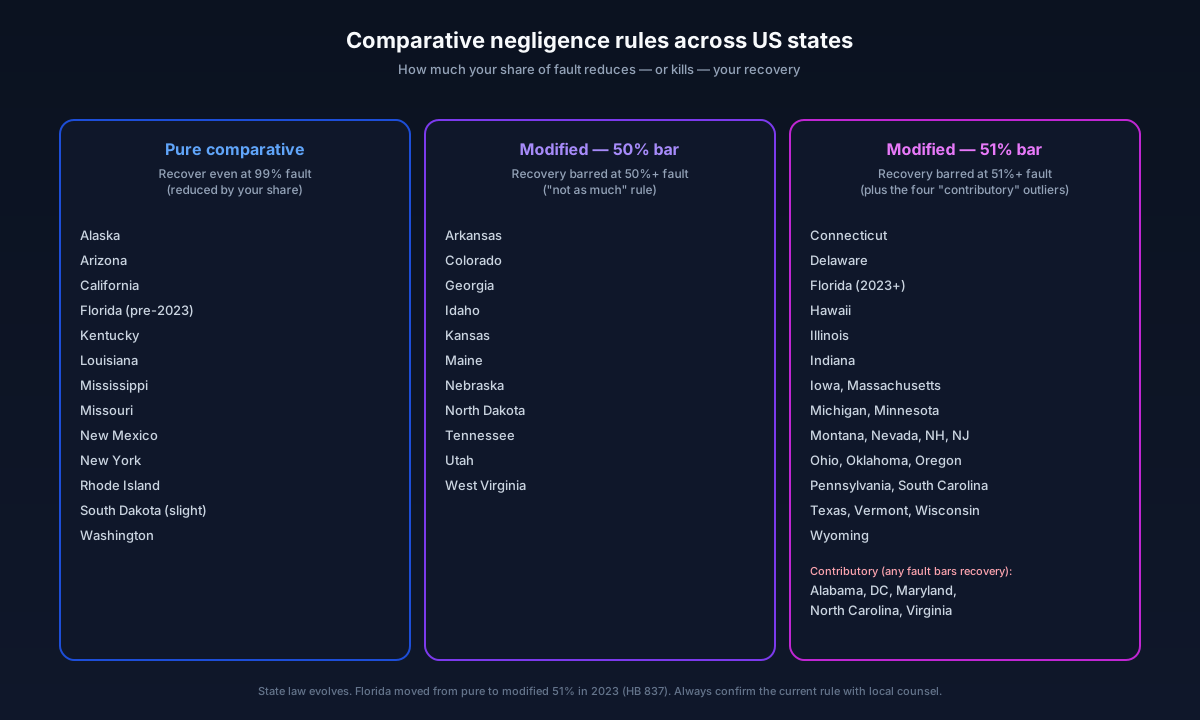
Almost every PI case involves some allocation of fault. Whether and how much the defendant pays often depends not on what happened to you, but on the percentage of blame the jury or insurer assigns to you. The rules fall into three families.
Pure comparative negligence. Twelve or thirteen states, including California, New York and Florida (pre-2023), let you recover even if you are 99 percent at fault — your award is just reduced by your share. A plaintiff who is 30 percent responsible for the crash and suffers $100,000 in damages recovers $70,000. A plaintiff who is 90 percent responsible and suffers $100,000 recovers $10,000.
Modified comparative — 50 percent bar. About ten states apply a 50 percent rule. If you are 50 percent or more at fault, you recover nothing. Below that, you recover with the standard reduction.
Modified comparative — 51 percent bar. Roughly twenty states apply a 51 percent rule. If you are 51 percent or more at fault, you recover nothing. Florida moved into this category in 2023 along with HB 837.
Contributory negligence (the outliers). Five jurisdictions — Alabama, Maryland, North Carolina, Virginia and the District of Columbia — still apply the harsh old common law rule that any fault on the plaintiff's part bars recovery entirely. If you are 1 percent at fault for being slightly inattentive when the truck blew through a red light at 50 mph, you may recover nothing. These jurisdictions are increasingly out of step with the rest of the country, but they remain hostile venues for plaintiffs. Knowing this rule before you talk to an insurer is critical — particularly with the recorded-statement trap from Section 2.
Comparative fault is litigated on the evidence. The police report is a starting point but not binding. Witness statements, dashcam footage, accident reconstruction, biomechanical analysis, traffic light timing studies — all feed into the percentage assigned by the jury. Even small movements (5 percent versus 15 percent) on large verdicts mean tens of thousands of dollars.
16. Frequently asked questions
How long does a personal injury lawsuit take?
The answer depends on the severity and complexity of the case. A soft-tissue rear-end collision settled pre-suit through a demand letter typically resolves in four to six months from MMI. A litigated case in state court that reaches mediation usually takes 18 to 36 months. Complex matters in federal court — medical malpractice, product liability, mass tort — frequently run two to three years or longer, especially when expert discovery and Daubert motions are involved. Catastrophic injury cases with permanent damages take the longest because MMI itself can be a two-year clinical process before any meaningful settlement discussion can occur.
What is the statute of limitations?
The statute of limitations is the legal deadline within which a personal injury lawsuit must be filed in court. It varies dramatically by state — from one year in Kentucky and Tennessee to six years in Maine and North Dakota — and varies further by claim type within each state. Government entity claims often require a separate notice of claim within 60 to 180 days, far shorter than the general statute. Filing even one day late triggers an automatic dismissal with prejudice, meaning the case can never be refiled. Section 14 has the full table, but always confirm with local counsel before relying on it.
Do I have to go to court?
Most personal injury cases never see a courtroom. Roughly 95 percent of all PI claims resolve before a lawsuit is filed, and of those that are filed, the great majority settle before trial — usually at mediation, sometimes on the courthouse steps. That said, you must be prepared to be deposed under oath during fact discovery, and you must be prepared to testify at trial if the case does not settle. Cases settle precisely because both sides have made an honest assessment that trial is risky. If you signal that you will never go to trial, the carrier knows it and prices the case accordingly.
What is MMI (Maximum Medical Improvement)?
Maximum medical improvement is the clinical point at which a treating physician determines that the patient's condition has stabilized and that further treatment is unlikely to yield meaningful additional improvement. The patient is either at baseline or has reached a permanent residual that further care will not change. MMI is the trigger for the demand letter — until you have reached it, your future damages cannot be calculated reliably. Settling before MMI almost always undervalues the case, sometimes by an order of magnitude in surgical cases where the full extent of permanent impairment is not yet known.
How much does a personal injury lawyer cost?
Almost all US personal injury work is taken on contingency. You pay nothing upfront. The lawyer advances case costs — filing fees, expert witness fees, deposition transcripts, medical record copies, sometimes investigator fees — and recoups those from the eventual settlement. The fee itself is typically 33.3 percent of the recovery if the case settles before a lawsuit is filed and 40 percent if a lawsuit is filed. Some states cap fees in medical malpractice cases on a sliding scale (California's MICRA, New York's Appellate Division rules). Read the engagement letter and ask about cost advances, fee reductions for pre-suit settlements, and what happens if you discharge the firm mid-case.
What if I was partially at fault?
The answer turns entirely on which state's rule applies. In pure comparative states like California and New York, you can recover even if you are 99 percent at fault, with your award reduced by your percentage. In modified comparative states with a 50 percent bar — including Arkansas, Colorado and Georgia — you recover nothing if you reach 50 percent fault. In 51-percent-bar states — including Texas, Illinois and Florida after 2023 — you recover nothing at 51 percent or above. In the five contributory negligence jurisdictions (Alabama, DC, Maryland, North Carolina, Virginia), any fault at all bars recovery. Your share of fault is litigated on the evidence, and small movements can matter enormously to the bottom line.
Will my medical bills be paid as I treat?
In no-fault (PIP) states — including New York, Florida, Michigan, New Jersey, Massachusetts, Kentucky, Pennsylvania (limited tort), Hawaii, Kansas, Minnesota, North Dakota and Utah — your own auto insurance covers initial medical expenses up to your PIP limit regardless of fault. Outside no-fault states, you typically treat through private health insurance, Medicare, or Medicaid, with their lien rights attached to any settlement. A growing third option is the letter of protection (LOP) — a provider treats now in exchange for a lien on your eventual recovery. LOPs are common in serious cases with no insurance coverage but they can complicate settlement and add cost. Discuss the trade-offs with your lawyer before signing.
What is the discovery process?
Discovery is the formal exchange of evidence after a lawsuit has been filed. It has four main tools: written interrogatories (sworn Q&A under FRCP Rule 33), requests for production of documents (FRCP Rule 34), depositions (live, sworn, transcribed testimony, FRCP Rule 30), and requests for admissions (Rule 36). In personal injury cases, the defense uses interrogatories to pin down prior injuries and witnesses, RFPs to obtain medical records and tax returns, and depositions to lock the plaintiff into their version of events. Each tool has procedural deadlines, scope limits, and rules around objections and protective orders. Discovery is the longest and most expensive phase of any litigated case, and it is where most cases are actually won or lost.
Can the insurance company force me to see their doctor?
Yes, under FRCP Rule 35 or the state procedural analog, when a party's physical or mental condition is in controversy, the opposing party can move to compel an independent medical examination (IME). The examiner is paid by the defense, chosen by the defense, and produces a report that is admissible at trial. The exam is not optional once a court orders it, but the plaintiff's attorney can attend or send a representative, can require recording in some jurisdictions, and can cross-examine the IME doctor at deposition and trial. Many defense IME doctors derive most of their income from insurance carriers; those numbers come out at trial and shape how juries weight their conclusions.
Is my settlement taxable?
Under 26 U.S.C. § 104(a)(2), compensation received "on account of personal physical injuries or physical sickness" is generally excluded from federal gross income — not taxable. That includes medical expense reimbursement, lost wages tied to a physical injury, and pain and suffering arising from a physical injury. Taxable categories include punitive damages, interest on a judgment, and emotional distress damages not arising from a physical injury or sickness. State tax treatment usually follows federal but can diverge. Structured settlements have their own tax rules. Always consult a CPA before signing a release, especially for seven-figure recoveries with mixed damages.
17. What to do next
If you were injured today, the rest of this week is more important than the rest of the year. In order:
Get medically evaluated. Document everything — every appointment, every bill, every conversation with an insurer. Lock down your social media. Decline recorded statements from the at-fault carrier. Preserve physical evidence. Note the deadline that applies in your state and accident type. Then, when you have a quiet hour, talk to a personal injury attorney for a free consultation.
There is no fee for the first conversation. There is no obligation to sign anything. There is no obligation to file a lawsuit. The point of the first conversation is to understand the timeline, the deadline, the likely value, the likely cost, and the likely path. If your case has merit, the lawyer takes it on contingency. If it does not, the lawyer should tell you so directly — and the right lawyer will.
Search our vetted attorney database to find a personal injury lawyer in your city. Review comprehensive legal profiles before booking a consultation. Find local counsel familiar with the venue's judges — the difference between a regional generalist and a PI-specific trial lawyer with twenty years in front of your county's bench is often the difference between a fair settlement and a great one.
The crash happened in a second. The recovery — physical, financial, legal — takes years. Knowing the timeline is the first step toward not being run over by it twice.
This article was reviewed by a licensed US personal injury attorney for general accuracy of legal concepts. It is not legal advice and does not create an attorney-client relationship. Personal injury law is state-specific and fact-specific; consult a qualified attorney in your jurisdiction before acting on anything you read here. Statutes of limitations, comparative negligence rules and procedural deadlines change; always confirm current law. Citations: NHTSA, Traffic Safety Facts: 2023 Data, DOT HS 813 723 (May 2025) at https://www.nhtsa.gov/; Bureau of Labor Statistics, Employer-Reported Workplace Injuries and Illnesses (2024) at https://www.bls.gov/iif/; Federal Rules of Civil Procedure at https://www.uscourts.gov/rules-policies/current-rules-practice-procedure; Daubert v. Merrell Dow Pharmaceuticals, Inc., 509 U.S. 579 (1993) at https://supreme.justia.com/cases/federal/us/509/579/; Mello MM, Studdert DM, Brennan TA, "The leapfrog standards: ready to jump from marketplace to policy?" published lines of NEJM 2009. State statute citations and the 2023 Florida HB 837 reform are summarized for general guidance.
Written by
Give Me A Lawyer editorial team
Find related help
Browse lawyers by location and practice area
For readers
Need a real lawyer for this?
Connect with a specialized attorney in your state — verified profiles, no commitment.
Find a lawyer now🛡️ For attorneys · From $2.99/mo
Want your firm to rank for this query?
Activate your Official Verified Badge ($2.99/mo) or upgrade your firm to Top 3 ($19.99/mo) with direct WhatsApp & Dofollow SEO backlink.